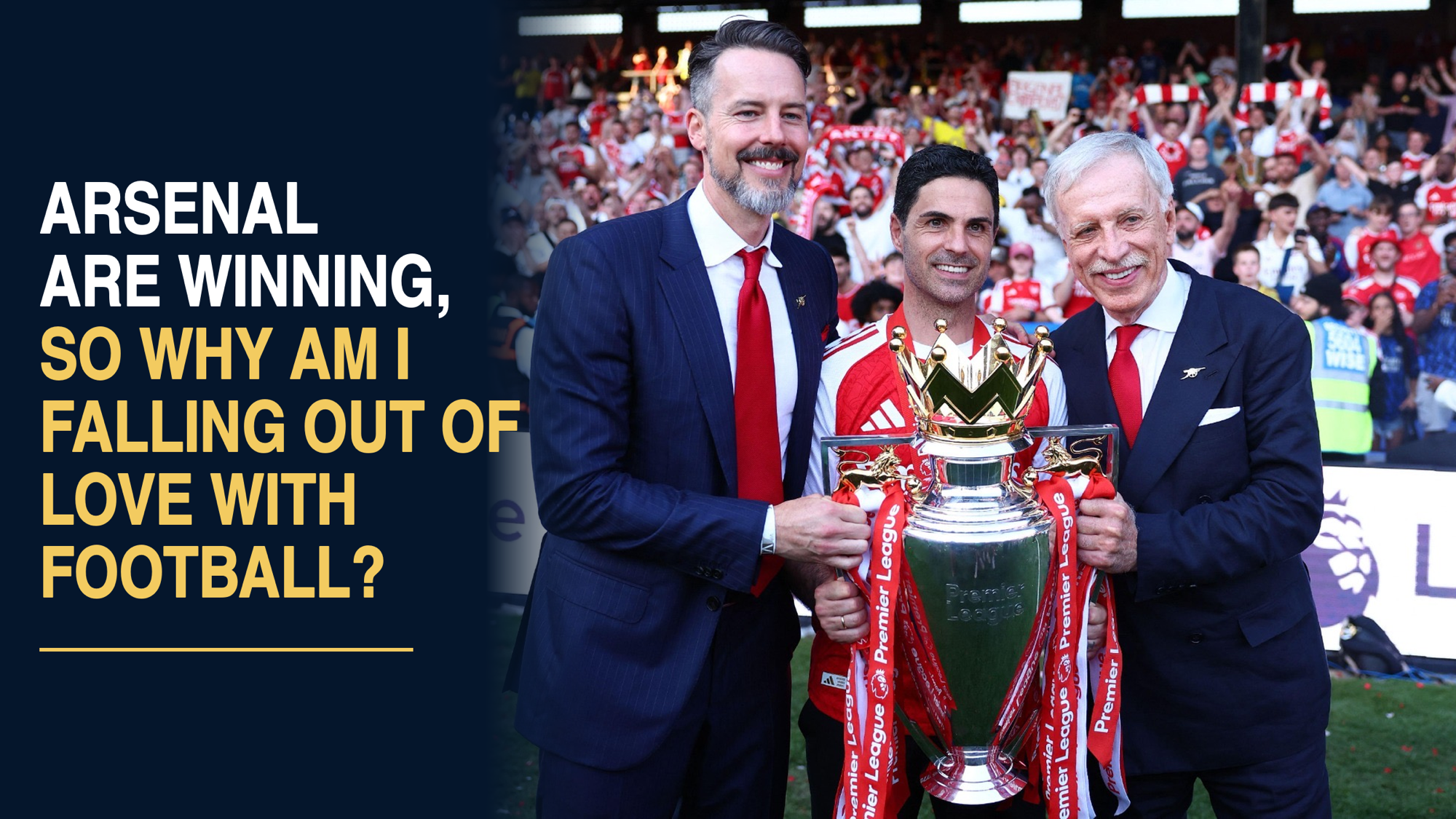
Arsenal Are Winning, So Why Am I Falling Out of Love With Football?

Arsenal are planning to cut up to 60 jobs. Their manager has reportedly agreed a contract worth £20 million a year. Their billionaire owner has seen his estimated wealth soar.

At a time when Arsenal are enjoying some of their greatest success in years, I should be happier than ever as a supporter. Instead, after more than three decades following the club, I find myself feeling increasingly disconnected from it.

My first Arsenal game was against Tottenham at Highbury in April 1995.

I was six years old. Ian Wright scored, Jürgen Klinsmann equalised, and I was hooked.

In the three decades since, I’ve followed Arsenal home and away, travelled across Europe to watch them and devoted more time, money and emotion to the club than I could possibly calculate. I’m still a season ticket holder today.

Arsenal have been a constant in my life. But increasingly, I find myself wondering whether I’m falling out of love with football.

Not because of results or performances. It’s everything else.

The proposed redundancies have brought that feeling into sharper focus. I don’t just question the decisions being made at Arsenal. I question what those decisions say about the game I’ve spent my life loving.

The People Behind the Numbers

Arteta’s response to the proposed redundancies only made things worse.

Asked about the decision, the Arsenal manager explained that it was intended to help the club evolve and improve, before talking about putting people in the right roles and continuing to invest in success.

I found his comments extraordinarily tone deaf.

Here’s a man who has just signed a contract worth £20 million a year, explaining why one of the wealthiest football clubs in the world needs to eliminate the jobs of ordinary employees in the pursuit of further success.

Arteta is not responsible for every financial decision Arsenal make. But he is one of the most influential people at the club, and his words carry weight.

Nobody expected him to publicly attack his employers. But surely he could have acknowledged the human cost of what was happening?

Instead, we got the kind of corporate language that increasingly defines modern football.

And the contrast with his predecessor could hardly be greater.

In 2020, Arsène Wenger spoke about the responsibility football clubs have towards their employees when deciding how much to spend on players.

“We are a club with 600 employees… we need to have a responsible attitude towards them as well.”

The contrast in language is striking.

One manager spoke about responsibility towards employees. The other spoke about evolving, improving and putting people in the right roles.

The Billionaire and the Balance Sheet

Then there’s the man at the very top.

Stan Kroenke’s estimated net worth has risen from approximately $8.2 billion in 2021 to $27.6 billion in 2026.

That’s an increase of $19.4 billion over five years.

Broken down, that’s roughly $10.6 million every single day.

Those figures represent changes in the estimated value of assets, not cash arriving in Kroenke’s bank account. Nor are an owner’s personal fortune and a football club’s operating budget the same thing.

But that distinction doesn’t settle the moral question.

Arsenal’s proposed redundancies are reportedly expected to save the club between £5 million and £7 million annually. Against the extraordinary wealth associated with its ownership, those savings raise an uncomfortable question about priorities.

Owning a football club comes with responsibilities that go beyond making the numbers work. Kroenke has the resources and influence to shape Arsenal’s priorities. How the club treats its employees should be among them.

There is something fundamentally wrong with a system that allows wealth to accumulate on such an extraordinary scale while ordinary employees are expected to sacrifice their livelihoods in the name of financial efficiency. The question isn’t just whether a decision saves money, but who is expected to bear its consequences.

And yet it’s ordinary employees who are being told that sacrifices must be made.

Arsenal even hired external management consultants to examine the business and identify savings. I’d love to know how much that exercise cost, and how much will ultimately be spent on the restructuring itself.

Perhaps the numbers make sense in a spreadsheet.

But if the only measure of a decision is whether it improves the balance sheet, we’ve lost sight of something far more important.

When Did Football Become Just Another Business?

Arsenal are a business. But being financially responsible should mean more than finding another way to cut costs.

But football clubs aren’t ordinary businesses. They’re woven into families, communities and identities across generations. My relationship with Arsenal began as a six-year-old walking into Highbury, not as a customer acquired by a marketing department.

What troubles me isn’t that clubs need to balance their books. It’s how readily their responsibilities to people can seem secondary to the numbers.

Employees become costs to reduce. Supporters become customers to extract more money from. Decisions that ought to involve questions of responsibility and principle become calculations about what best serves the club’s interests.

The Club I Love, and the Things I Can No Longer Ignore

The redundancies aren’t the only reason I’ve become disillusioned with modern football. They’re the latest reminder of how much the game has changed.

Ticket prices keep rising, without the matchday experience necessarily feeling any better. But it’s the constant effort to commercialise every part of football that wears me down. There’s an official partner for seemingly everything, from the ball to the seats in the dugout. Even the smallest details feel like another opportunity to sell something.

None of that is as serious as people losing their jobs. But it adds to the feeling that a club I’ve loved since childhood increasingly sees supporters through the lens of what they can spend.

And then there are the much more serious questions about the moral responsibilities of football clubs.

Arsenal’s handling of the Thomas Partey situation was particularly difficult for me.

The allegations were extraordinarily serious, and I found the club’s approach deeply uncomfortable.

What troubled me was the contrast with how ruthlessly Arsenal had dealt with other players during Arteta’s early years.

We’d seen players have their contracts terminated, others allowed to leave for reduced fees and difficult decisions made in the name of changing the culture of the football club.

Those were different decisions, made in different circumstances. But they showed how willing Arsenal could be to act decisively when the club believed change was necessary.

Arsenal continued to select Partey. In June 2025, the club also confirmed that discussions over a new contract were ongoing. That, more than any rumour, brought my discomfort into focus.

I understand the importance of due process and the presumption of innocence. Serious allegations do not automatically establish guilt, and I’m not suggesting the club should have treated them as though they did.

My question was how Arsenal weighed its wider moral responsibilities against its sporting interests. Whatever discussions took place behind closed doors, I struggled with the decisions supporters could see.

We’d heard so much about standards, culture and doing things the right way. Yet I struggled to reconcile that language with what I was watching unfold.

It was the closest I’ve come to being completely done with the club.

It all contributes to a growing sense that winning, protecting commercial interests and maximising revenue have become the overriding priorities.

Remembering Why I Fell in Love With Football

For all my frustration with Arsenal and the professional game, there are still moments that remind me exactly why I fell in love with football.

Increasingly, those reminders come from outside the Premier League.

My second cousin plays for Brighton’s Under-21s. Watching him takes me back to the football I grew up with in the 1990s and 2000s.

When I’m watching him, I’m not thinking about commercial partnerships or how much money somebody can squeeze from the next matchday. I’m watching someone I care about play football, develop and enjoy the game.

Football was already big business when I was growing up. But it still felt rooted in communities, rather than packaged as a product with a sponsor attached to every part of it. It felt like football belonged to us.

When I was growing up, some of my happiest memories were of playing football in the park with my mates. After school, during the holidays, whenever we could get enough people together.

Jumpers for goalposts. Arguments about whether the ball had crossed the line. Pretending to be Ian Wright or Dennis Bergkamp. Playing until it was too dark to see.

Nobody was telling us where to stand or when to press. Nobody was analysing our performances or worrying about our development.

We were just playing football.

And it was brilliant.

I don’t need football to be exactly as it was then. But I miss how little it seemed to ask of us beyond turning up and loving it.

A Game of Two Worlds

The contrast between the top and bottom of football is staggering.

At one end, we have enormous commercial deals, players earning hundreds of thousands of pounds every week and clubs constantly searching for new revenue streams.

At the other, grassroots clubs rely on volunteers, parents give up their evenings and weekends, and communities struggle to maintain the pitches and facilities that allow children to play.

The money at the top of the game has never been greater. Yet the distance between those two worlds seems to grow every year.

Football used to feel like an escape from the world around us. Now, increasingly, it feels like a particularly exaggerated version of it.

What I keep coming back to is what football has given me over the years.

Some of my happiest memories have nothing to do with the result of a match. They’re about the people I was with, the places we visited and the shared experience of supporting Arsenal, from Highbury to away days across Europe.

You can’t put a commercial value on those things.

Or at least, you shouldn’t.

I understand that competing at the highest level requires investment and difficult decisions. But treating employees responsibly, respecting supporters and recognising a club’s place in its community shouldn’t be optional extras.

The redundancies may make financial sense to those making the decisions. I wonder what they cost in loyalty, trust and identity, things that don’t fit neatly into a balance sheet.

I’ll still be at the Emirates. I’ll still celebrate the goals, get frustrated by the defeats and care far more than I probably should about the results.

Thirty years of supporting Arsenal doesn’t just disappear.

But with every decision like this, I feel a little more disconnected from the club I’ve spent my life loving.

And increasingly, I find myself enjoying football most when I’m watching my second cousin play, standing beside a grassroots pitch or remembering those afternoons in the park.

Maybe that’s because those are the places where football still feels like football.

I don’t think I’ve fallen out of love with the beautiful game.

I’m just not sure I love what we’ve turned it into.

27 responses to “Arsenal Are Winning, So Why Am I Falling Out of Love With Football?”

  1. Matt Avatar
    Matt

    I feel very similar. Anfield ST holder since 1995. Waited a long time to see us win a league… I think having seen that, in the best way by beating spurs at home in April 2025, the game is up for me. One additional thing for me is the chasm between us fans and the players; they are nothing like me. I can’t related to them, they can’t relate to me. We have nothing in common. I find it very difficult to feel anything but contempt for football now. My days are numbered.

    Enjoyed the article

    1. Dave Gray Avatar

      Thank you. Really appreciate you reading. I completely get you. Winning the league last year was still an amazing moment for me, but I find it so hard to look past all the things that just turn me off from football almost every week. I used to have such big highs and lows from football in the best way, but I almost just don’t care too much either way any more and I hate that.

    2. Ae Avatar
      Ae

      As much as I love football and my team I feel guilty giving them so much attention or even money. I’ve never owned a season ticket but looking at fans traveling home and away and investing so much money into their clubs is embarrassing. These guys couldn’t give 2 sh*ts about you and if anything happened they wouldn’t even donate a pound to you

  2. David L Avatar
    David L

    Great read Dave. I’m a bit older than you so the change feels even worse for me. I was a season ticket holder at Spurs until this season but I just don’t feel it’s worth it now. The game has become so unenjoyable. Every tournament has more teams, more games, more money….none of it feels special any more. The PL is, on the whole, stale and although it’s been less intrusive this season, VAR is a terrible addition. Unfortunately all sport is going this way, not just football. Eventually greed will ruin them all.

    1. Dave Gray Avatar

      Thanks for reading mate. Really appreciate it.

      Hard to disagree with why any of that. I think fans are just an afterthought now, unless it’s going to somehow make them more cash.

  3. Steven Francis Avatar
    Steven Francis

    Great article. I have been a Liverpool season ticket holder since 1994, I missed 1 year of European football when we were in the Europa league and I have been kicked off the list for tickets ever since. My loyalty holds no value and the club would boot me out my seat at any opportunity for a day tripper, being a local supporter of many years I am the minority in the ground and I believe the atmosphere and match day experience is deteriorating.

    1. Dave Gray Avatar

      Really appreciate you taking your time to read it. Thank you

  4. TA Avatar
    TA

    Great article, enjoyed the read!

  5. Irons Avatar
    Irons

    I feel the same. I’m a lot younger but leaving Upton Park was the day the club I loved died. We may have been shit but I used to look at the arsenals and Liverpool’s etc and feel so glad we wasn’t like them but we’ve become everything we hated. I’ve still got my season ticket purely for the handful of aways I still want to go to but going over for a home game every Saturday used to be something I’d look forward to every week and now I couldn’t think of anything worse

  6. Huw Richards Avatar
    Huw Richards

    Fine piece. That comment about the way that something which should be an escape from other realities is instead becoming an exaggerated version of them is highly perceptive, and applies in other sports – both codes of rugby abolishing promotion and relegation for instance. Does help to explain the increased appeal of non-league football. There’s money there too, but it does not squeeze out other considerations

  7. Steve Avatar
    Steve

    An excellently articulated article, Dave, that pretty much sums up how I currently feel.

    First game for me at Highbury as a boy was in the 89/90 season and, watching on from the East Stand Lower, I fell completely and immediately in love, as you did.

    Local N1 Cally born and bred, I’ve been based in the Far East for two decades, and did wonder if geographical distance was a factor, in addition to the sentiments I mostly share with you.

    It’s not. If anything, the bond is stronger due to being so far away from home. But I cannot help feeling this latest announcement pulls me a little further away in the feels.

    I’ll always love the Arsenal, but the corporate/commercial side does continually impact my love for the wider game, and leaves me wondering where I’ll sit with all this in 5, 10, or 15 years from now.

  8. Mick Avatar
    Mick

    Superb read Dave. I’ve been an Arsenal fan since 71 – the Charlie George celebration with him lying flat on the floor after scoring, looking around captured me for some reason.

    I saw one game at the old Highbury, did the stadium tour there, and have only managed 2 games at the Emirates.

    It was simple affordability on the home front that prevented me from committing further to the club in terms of membership, Sky, and replica kits and so on.

    As you’ve highlighted, the “official partner” aspect has now become woven into the modern game like corporate Japanese knotweed – it’s horrible to see.

    And these latest redundancies are so disappointing to see; why couldn’t they simply put a hold on further recruiting, and look after what we have?? And so close to Christmas as well, and announced – as far as I recall – the day after Ken Friar’s passing.

    Thanks for the article….

  9. Andrew Pettifer Avatar

    Firstly a confession – I’m a lifelong Spurs fan. Your article is spot on, and not just because you’re questioning goings on at Arsenal. Much of what you say can apply to most Premier League clubs and certainly to Tottenham. (Although I do agree that the Thomas Partey situation reflects particularly poorly on Arsenal and the CEO at the time. I wonder where he is now… oh, hang on a minute…) I’ve written a couple of books about following Spurs and the conclusion I have come to is it is not the club that I value but fandom. Being part of a community that speaks to history, companionship and identity. With young fans largely being priced out of attending matches and the corporatisation of the whole experience I do wonder whether the level of connection that you and I feel to our clubs will not be so prevalent in the future. Layering that thought on top of the impact of the various financial irregularity (ie cheating) scandals does beg the question whether the heyday of English football has passed and it’s a slippery slope from here?

  10. Keeks Avatar
    Keeks

    American Barcelona fan (since 2013; I’ve been to Spain and I have season tickets to my local club, too. In the first stand, at that) and I fully agree.

    Constantly we’re seeing deals and ads and talking about contracts and transfer windows and 115 charges…what about the football? Not the Hater Central posts or bellyaching about the Ballon D’or but people just enjoying it.

    Why is Mason Greenwood (among others) still playing? Why are teams signing deals with Israeli companies, hell, why hasn’t Israel been kicked out of the game as a whole?

    There is just so much in the game which is confusing and exasperating, lately.

    A lot to think about. Loved the article mate, and congrats on the title!

  11. Nick Avatar
    Nick

    Had an Arsenal ST in 93. Started going in 84. People may disagree but I’ve been saying for the last 10yrs that the money involved in the game means it’s completely open to corruption. Everything feels fixed.

    I loved Arsenal winning the league last season but I didn’t jump up and down in the same way as when Bould put Adams through against Everton. Football is now just commercial. Similar to American wrestling in my eyes.

    A great read Dave and spot on regarding staff and Partey.

  12. Bill C Avatar
    Bill C

    Arsenal are a large reason as to why I’ve fallen out of love with football. All the organised wrestling at corners, two minutes to take every set piece, the lack of red cards or penalties for the whole season last year also left neutrals become conspiracy theorists that they used to laugh at.

    Appreciate it’s not just Arsenal that have this win at all costs attitude, but they’re the poster boys.

    And Arteta jumping around and leaving his touchline area constantly is head wrecking.

    Nice piece on the other items as well.

    1. Mat Avatar
      Mat

      Talk about missing the point of the article snd just piling in with your own tabloid driven agenda…

  13. Andrew Avatar

    Good stuff.

  14. Dave Hedge Avatar
    Dave Hedge

    Brilliant read. ST at the Villa, and like you, home, away and Europe, it’s been a massive part of my life since I was a kid. But for reasons like yours, and seeing corporates and tourists given priority over regulars makes me sick. Areas we drank in are now GA+ only. You don’t even get Villa TV with the hugely expensive ST anymore, it’s the little things. We went to watch a Vitesse Arnhem game last season and it was a throwback to just enjoying football without all the pointless add-ons. The trouble is, football is a drug that’s very hard to give up, despite how much I don’t like it very much right now.

  15. Daryl Williams Avatar
    Daryl Williams

    Great article mate. Chelsea season ticket holder since 1996/97. Very similar age and football experience as you. Massively resonate with the simplicity of playing with your mates as a kid and seeing it now at grass roots level. My daughter has just started playing and I see it in her which is great. It’s all so overly coached and commercialised at the top level now as you say.

  16. Michael Avatar
    Michael

    . It’s such a normal process for any sports team to go through and of course it gets magnified bc it’s arsenal. I’ve worked for 2 major US sports teams and both had 3x major layoffs in my 2 years at both. Yes…6x in less than 5 year more than 15-20 people got laid off and weren’t replaced at these teams. It’s also very ignorant to assume the same money that goes into artetas contract and transfers is the same money that goes to the business staff. I made crap money at both the NY islanders and NY Jets yet the Jets coach that got fired while I was there got paid out over $12m for it. The sporting sides of these businesses do not overlap with the business sides like you’d think. I appreciate the article, it’s not as black and white as this.

  17. Rich Avatar
    Rich

    Agree with you. I think as a Liverpool fan was a bit sheltered from the crapness of modern football because of how great we had it under Klopp. But that was the period I stopped watching other games and the enjoyment became affected by VAR.

    Last season the football was so dull and slow I’ve never been so bored watching it. I can accept losing but the business and money side has taken the soul out the league, so it needs a great on pitch product to make up for it. But the football through the league is awful. No flair left.

  18. Hanibal Ali Avatar
    Hanibal Ali

    Really enjoyed the read. While I am on the younger side as a supporter, having only really been a United fan since ’07, I still cannot ignore just how commercialized the sport has become.

    Some part of it might have to do with on-the-pitch performances, but I feel more and more like a neutral supporter nowadays. I wouldn’t even get mad at Man City if they win the league, even after their charges, because I just don’t care anymore. Apathy is probably the correct term.

    This is mostly just a comment on the modern game, but with transfer fees getting more and more exhorbitant, and clubs & their facilities trying to cut more and more corners to continue being the best. We are slowly reaching a point where the game will simply become inaccessible to supporters and lower-tier clubs, who must accept that this new era of football simply does not care about them.

    However, in times like these, one should also focus on the good things in life. I have been playing in my local Sunday League team, and I would honestly say that it’s slowly been helping me appreciate football again, reminding me why I love the beautiful game so much.

    Again, hats off to you for the great article!

  19. Tom Avatar
    Tom

    Great read and you’ve hit the nail on the head with so many points. I love going to premier league games but will only go in the away end for £30 (which those are of course hard to come by) – the price of home tickets these days are just not worth it for the diminishing product. I was surprised you didn’t mention this as a reason given the freedom of footballers has been taken away from the game, everything is now so robotic. I’m a Liverpool fan and last week with the Man City charges, bizarre refereeing decisions are all questioning my love for the game and whether I can be bothered any more.

  20. Adam Avatar
    Adam

    I’m a Carlisle fan (much maligned). We’ve been rubbish for most my life but much of what you say is filtering down to the point where watching community football is even becoming more attractive as everyone chases success polarising the leagues and authenticity of the game. Our new chairman did an interview last week where he said, if it wasn’t for our owners now, we’d be out of business. It’s very likely true and points to the unsustainability of meeting fan expectations on the traditional revenues football generates. Much of what you say sits within the wider culture of life and cost of living we see in front of us. Rather than providing escapism, Premier League football contributes to the challenges now for people. Hundreds of pounds for tickets, memberships, £150 for kits, expensive, poor quality food, ‘Wallet share’. You’d have thought Arsenal could have absorbed those redundancies through natural loss and redeployments, but alas, no. Friends are Man Utd fans and that is genuinely even worse! They don’t want traditional fans, they want tourists who’ll pay a higher ticket price and spend hundreds of pounds in the shop. Putting profit before what the institutions were built for, the Americanisation of our sport.

  21. Joe Buckley Avatar
    Joe Buckley

    Probably the best article I’ve read on the beautiful game in years and one which so succinctly describes every aspect of the fatigue, weariness and apathy I feel for the state of the modern game.

    I’m about a decade older than you and an Evertonian. I was lucky to see my beloved blues be the best in the land and lift our only European trophy before I was 10. I genuinely have no idea how blues under 40 have any appetite whatsoever.

    I genuinely think it’s gone past apathy for me now though, to actual revulsion. I found Arteta’s comments last week eye wateringly bad, they almost made you wince. Almost like the Arsenal PR and Comms filter in his brain had crashed and he just said what he really felt and sadly, probably always had. And I say this as an Evertonian who genuinely adored Arteta.

    The Premier League itself and of course Infantino and FIFA are now so morally bankrupt, that being seen as merely corrupt doesn’t seem a concern, nor the continuing prostitution of the “product”. Combining these ills with the Man City debacle, PSR/SCR/VAR and the horrific doubling in costs (pre Covid a ticket, drink and transport probably set me back £80ish it’s now over £150 per match) it’s becoming very, very hard to care or God forbid…enjoy it. Because you so rightly say, so much is taken from it.

  22. Steve Avatar
    Steve

    Brilliant article! Agree with every sentiment! I am 61yo MUFC ST holder. Saw plenty of lean years before the glory years. Still can see Choccy’s penalty miss at The North Bank in 1988! Can cope with lean years after the Lord Mayors show but it’s all different now. Players detached from the fans more than ever. Ownerships purely motivated by £££. Or Sportswashing. Stupid kick off times. VAR makes the stadium fan irrelevant. Just extras in a movie now. Will the game ever go back to the working man…i fear not sadly. Local team Altrincham calling me now!

Leave a Reply

Discover more from Taproom Network

Subscribe now to keep reading and get access to the full archive.

Continue reading