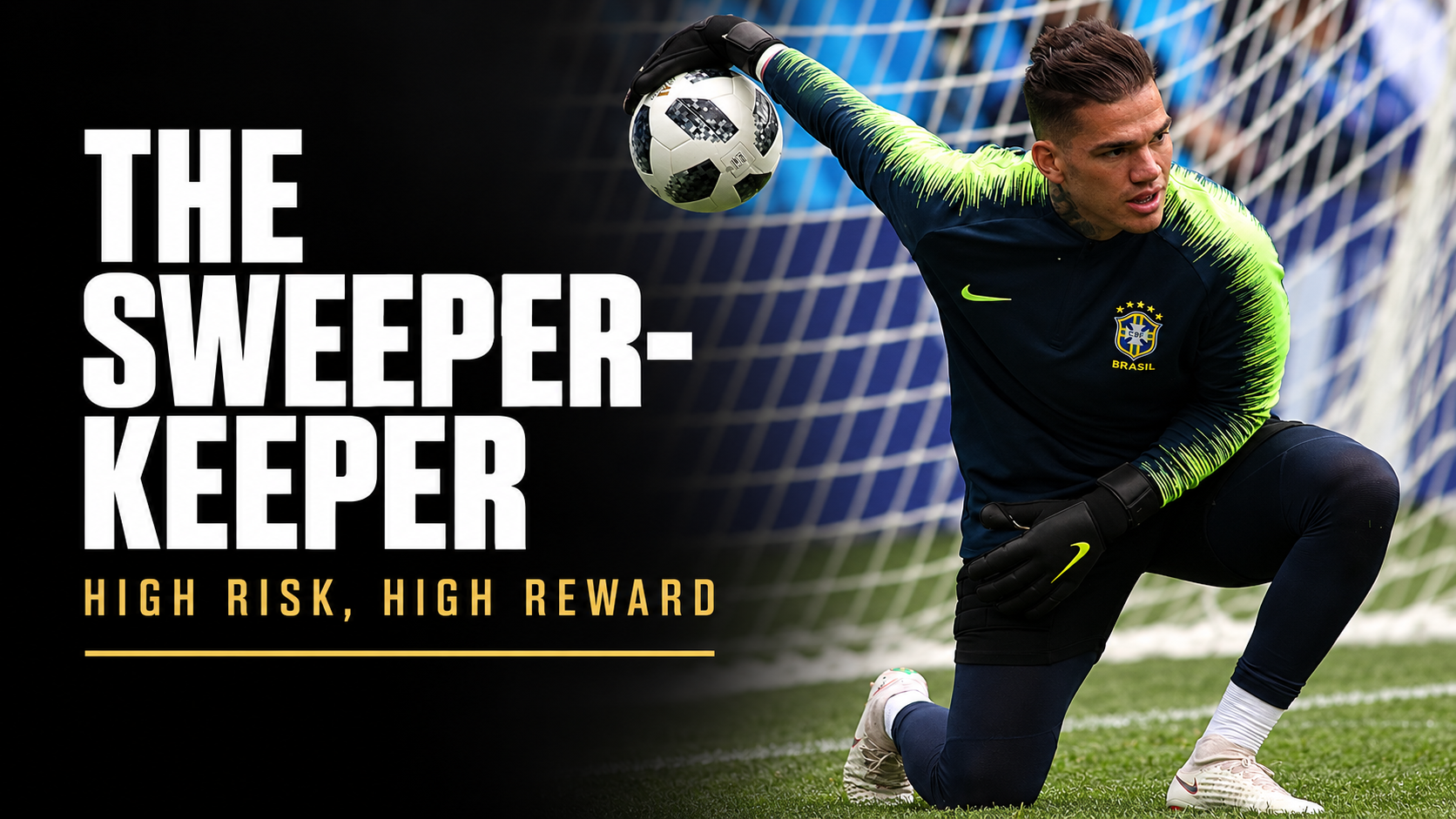

For over a century, football defined the goalkeeper by a simple mandate: keep the ball out of the net. Positioned firmly inside the six-yard box, traditional shot-stoppers were evaluated on reaction speed, handling under pressure, and aerial presence during set pieces. Long kick-outs downfield were acceptable as long as the danger was cleared.
That era is over. Driven by high-pressing schemes, numerical superiority in possession, and positional play, the modern goalkeeper has evolved from a defensive safety net into an outfield playmaker. Today’s elite teams no longer want an isolated shot-stopper; they demand an eleven-player passing unit starting from the penalty box.
Tactical Blueprint: Beating the High Press
When opposition forward lines deploy aggressive, high-intensity presses, they target centre-backs and defensive midfielders to force turnovers in dangerous zones. A ball-playing goalkeeper disrupts this entire defensive system by creating a permanent 11v10 numerical overload in build-up phases.
Line-Breaking Passes
Rather than hoofing clearance kicks toward contested aerial duels, a proficient sweeper-keeper invites pressure, holds the ball until a forward commits, and delivers crisp, line-breaking passes through the central channels or out to inverted full-backs. By acting as the base of a build-up triangle, the keeper turns opposition pressing intensity into an open highway for counter-attacks.
Direct Transitions & Launch Distance
Modern playmaking goalkeepers do not rely exclusively on short distribution. When opposing defences push high up the pitch to suffocate short passing lanes, a keeper with elite range can launch precise 60-yard passes directly to wide wingers or run-makers behind the defensive line, forcing the opposition defence into immediate retreat.
Risk vs. Reward: High-Line Defence and Transitions
Operating high outside the 18-yard box introduces clear tactical trade-offs:
- The High Defensive Line: Playing 20 to 30 yards off the goal line allows the team’s outfield structure to condense into the opponent’s half, maintaining continuous pressure and minimising space between lines.
- Sweeping Behind the Line: The keeper functions as a deep sweeper, rushing out to head away long balls or make decisive tackle interceptions before an attacker reaches open space.
- The Vulnerability: Any miscalculated touch, delayed pass, or poor decision outside the penalty box leaves the goal completely unguarded. The threshold for error is zero: an error by an outfield playmaker might cause a turnover in midfield, but an error by a sweeper-keeper almost always leads to a goal.
Profiles in Modern Goalkeeping: Elite Case Studies
The modern market categorises goalkeepers into three distinct profiles depending on their balance of shot-stopping and ball distribution:
The Complete Hybrid: Ball-Playing & Shot-Stopping
- Alisson Becker (Liverpool): The gold standard of balance. Alisson combines world-class 1v1 shot-stopping with exceptional spatial composure. His ability to initiate rapid counter-attacks with long-range distribution (such as his famous assists to Mohamed Salah) complements his proactive positioning outside the box.
- Mike Maignan (AC Milan): A commanding presence who reads passing lanes like a centre-back. Maignan boasts remarkable passing range alongside commanding aerial claim ability and explosive reaction saves.
The Specialised Playmaker
- Ederson (Manchester City years): The ultimate outfield player in gloves. Ederson’s composure under extreme pressure is unmatched; he routinely executes low-driven passes past pressing attackers. While his raw shot-stopping metrics are sometimes lower than pure shot-stoppers due to facing few shots per game, his distribution was a fundamental pillar of Pep Guardiola’s tactical structure during his time at Manchester City. He joined Fenerbahçe in September 2025.
Traditional Shot-Stoppers adapting to Modern Demands
- Jan Oblak (Atlético Madrid) & David de Gea (Historically): World-class shot-stoppers who thrive in deep-block systems where box protection is paramount. However, their reluctance or reduced comfort in sweeping high outside the box or playing line-breaking passes highlights why teams demanding possession-dominant football often struggle with purely traditional profiles.
The Future Market: What Clubs Look For in Prospects
The transfer market for goalkeepers has undergone a permanent shift. Scouting reports for young prospects no longer start with reflex saves; they begin with foot preference, spatial awareness, and composure under pressure.
Clubs are investing heavily in future-ready prospects who possess:
- Ambidexterity (Two-Footedness): The ability to clear or pass with either foot prevents opposition presses from forcing the keeper onto a weak side.
- Cognitive Spatial Mapping: Reading the movement of pressers 2-3 seconds before receiving the ball.
- Midfielder Youth Backgrounds: An increasing number of modern academy goalkeepers spend early developmental years playing as outfield midfielders to build natural comfort on the ball before specialising in goal.
Psychological & Communication Dynamics
The Field General: Defensive Architecture
- 360-Degree Vision: Positioned behind all 20 outfield players, the keeper acts as an on-field coach, reading plays before they unfold.
- Micro-Adjustments: Elite sweeping is preventative; keepers constantly direct centre-backs to step up, drop back, or close passing lanes to maintain compactness.
- Vocal Authority: Clear, decisive calls cut through stadium noise to claim space and organise the penalty box during chaotic transitions.
Mental Resilience & Nerves of Steel
- Selective Amnesia: Because a goalkeeping mistake directly costs a goal, elite keepers instantly erase blunders to avoid playing conservatively for the rest of the match.
- Press Baiting: Inviting pressure requires absolute composure, waiting until the last second before passing past sprinting attackers.
- Composed Leadership: Calm body language prevents anxiety from spreading through the backline after high-pressure moments or mistakes.
Cognitive Load & Rapid Scanning
- Dual-Mode Switching: Sweeper-keepers rapidly alternate between a playmaker’s spatial awareness and a shot-stopper’s explosive reflexes.
- Pre-Pass Scanning: Top keepers scan the field 2-3 times before receiving a back-pass, mapping out pressers and escape routes in advance.
While turning your goalkeeper into an extra outfield player creates an instant build-up overload, it introduces high-stakes vulnerabilities that can shatter a defensive structure:
- Zero Margin for Error: A misplaced pass or heavy touch outside the 18-yard box leaves an empty net, converting standard turnovers into immediate conceded goals.
- High-Line Exposure: Misjudging a 30-yard sweep to intercept a long ball risks missing the clearance entirely, leading to open-net finishes or straight red cards.
- Targeted Press Traps: Opposition managers deliberately design pressing traps to force ball-playing keepers onto their weak feet under heavy physical pressure.
- Positioning Blindspots: Staying active outside the box leaves keepers vulnerable to instant long-range chips or quick shots off unexpected turnovers.
- Cognitive Fatigue: Managing split-second playmaker decisions alongside peak shot-stopping reflexes creates extreme psychological strain over 90 minutes.
- Systemic Fragility: Tactical systems reliant on an elite sweeper-keeper risk total collapse if an injury forces a traditional backup into the lineup.
Conclusion
The evolution of the sweeper-keeper represents one of the most radical tactical shifts in modern football. No longer restricted to hand-based shot-stopping within the 18-yard box, the modern goalkeeper is an active participant in dictating a team’s tactical structure, press resistance, and attacking rhythm.
As pressing schemes become more aggressive and athletic across world football, clubs that deploy a goalkeeping playmaker effectively play with an extra player in every phase of build-up. The shot-stopper of yesterday has officially become the outfield quarterback of today and there is no turning back.
Leave a Reply