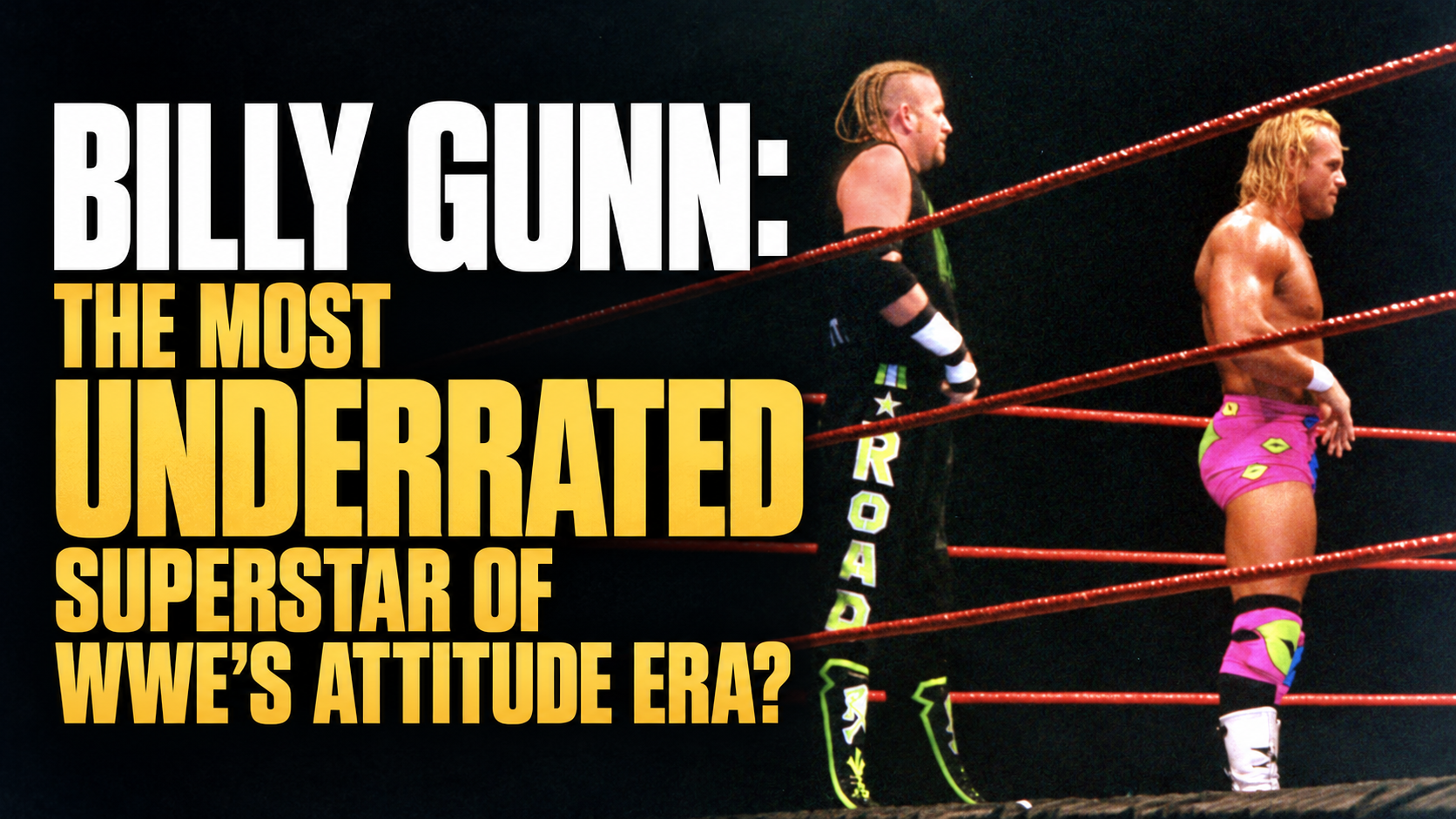

From the cowboy days of the Smoking Gunns to the rebellious chaos of D-Generation X, the outrageous Mr. Ass, the short-lived promise of The One and the boundary-pushing partnership of Billy & Chuck, Billy Gunn deserves far more credit for his place in wrestling history.
When people talk about WWE’s Attitude Era, certain names dominate the conversation. Stone Cold Steve Austin, The Rock, Triple H and Shawn Michaels are rightly remembered as the men who helped transform professional wrestling into must-watch television.
But what about the performers who helped make that era what it was without always receiving the same recognition?
What about Billy Gunn?
For a man who spent years standing alongside some of the biggest personalities in wrestling, Gunn has often been overlooked when discussions turn to the most underrated performers of the 1990s. He might never have reached the summit occupied by Austin or The Rock, but his career is a fascinating story of athleticism, memorable characters and finding success in an era of larger-than-life personalities.
From one half of the Smoking Gunns to the brash New Age Outlaws, through the revolutionary chaos of D-Generation X and into the world of Mr. Ass, Billy Gunn was far more than just the other bloke standing next to Road Dogg.
And his story didn’t end when the Attitude Era did.
From cowboy boots to championship gold
When Billy Gunn arrived in WWF in 1993, he was a long way from the loud, rebellious character wrestling fans would eventually come to love.
Teaming with Bart Gunn, who played his on-screen brother, the pair became the Smoking Gunns. With their cowboy hats, country-inspired presentation and straightforward, hard-hitting wrestling style, they fitted neatly into the traditional tag team landscape of the early 1990s.
The Smoking Gunns weren’t built around controversial storylines or outrageous promos. They were athletic, dependable and believable as a team, eventually capturing the WWF Tag Team Championship three times.
Their success shouldn’t be dismissed simply because they weren’t delivering profanity-filled promos or smashing televisions on Monday Night Raw. The tag team division was an important part of WWF programming, and the Smoking Gunns were a credible presence within it.
Billy had the size and strength to be a convincing heavyweight while retaining the agility to move around the ring with surprising ease. Yet being a good tag team wrestler and becoming a memorable singles star are two very different challenges. For a while, it looked as though Gunn might spend his entire career occupying the former category.
Then came Rockabilly.
Rockabilly: A career looking for direction
By 1997, the Smoking Gunns were finished, and Billy found himself in a strange position. His new persona, Rockabilly, saw him paired with the Honky Tonk Man in a rockabilly-inspired act that never quite caught fire.
The gimmick struggled to connect, and Gunn appeared to be drifting towards the sort of mid-card obscurity that swallows talented wrestlers whole. He had the physical tools, but the character wasn’t giving audiences a compelling reason to care.
Then WWF paired him with another wrestler who had struggled to establish himself as a star in his own right: Road Dogg Jesse James.
On paper, the combination had no obvious reason to work. Together, however, they became the New Age Outlaws.
Sometimes wrestling magic doesn’t require a five-star match or an elaborate long-term storyline. Sometimes it just needs two performers whose personalities click.
The New Age Outlaws: Two men, two words, one unforgettable act
The New Age Outlaws emerged in 1997 and quickly became one of the most entertaining tag teams in WWF.
Road Dogg was the talker, delivering the introductions and promos with a distinctive rhythm, swagger and sense of humour. Billy Gunn was the powerhouse, providing the athleticism, physical presence and cocky attitude that completed the pairing.
Their entrance routine became a spectacle in itself. Road Dogg would introduce the team, building towards the familiar declaration that if the audience wasn’t down with D-Generation X, they had two words for them.
The crowd knew exactly what to do next.
It was simple, memorable and perfectly suited to the live environment. Fans weren’t just watching the New Age Outlaws. They were participating in the show.
But their success wasn’t built on catchphrases alone. They were convincing champions who could hold their own against established teams, and their rivalries with acts such as the Legion of Doom helped establish them as more than a novelty.
Their feud with Cactus Jack and Chainsaw Charlie, culminating in a dumpster match at WrestleMania XIV, remains one of the memorable chapters of their tag team run.
The New Age Outlaws went on to capture the WWF Tag Team Championship multiple times, establishing themselves as one of the signature teams of the late 1990s.
Road Dogg’s microphone work naturally attracted attention, but the team needed someone who could provide the physical credibility to match the personality. Gunn was that man. He wasn’t merely standing there waiting for his catchphrase. He was an integral part of the act.
And then came D-Generation X.
D-Generation X: Helping change the face of WWE
If the New Age Outlaws made Billy Gunn a star, D-Generation X helped make him part of something much bigger.
DX began with Shawn Michaels, Triple H, Chyna and Rick Rude. As the group evolved, the New Age Outlaws and X-Pac became central members of its next incarnation.
This was the Attitude Era in full flight.
WWE was pushing boundaries, embracing irreverence and challenging the polished, family-friendly presentation that had characterised much of its earlier product. DX mocked authority, disrupted broadcasts, taunted rivals and refused to behave as professional wrestling’s establishment expected.
They were loud, crude, unpredictable and enormously entertaining.
Their significance went beyond the jokes. DX helped establish a style of wrestling television that felt more contemporary, less formal and more connected to the rebellious popular culture of the late 1990s.
It would be wrong to suggest DX alone revolutionised WWE. Austin, Vince McMahon, The Rock, Mick Foley and countless other performers and creative figures were central to that evolution. But DX was one of the most visible expressions of it.
Gunn helped give the group a credible tag team presence, ensuring DX could be involved in championship programmes as well as comedy segments and confrontations. The New Age Outlaws were not simply supporting characters who happened to wear DX merchandise. They were champions and major attractions in their own right.
DX made rebellion entertaining, and the New Age Outlaws gave that rebellion a tag team people genuinely wanted to watch.
For Gunn, it was arguably the most successful period of his career. Yet WWE still seemed to believe there was a potential singles star waiting to break through.
Mr. Ass: A character that should never have worked, but did
If there was one thing the Attitude Era proved, it was that WWE was willing to embrace characters that would have been unthinkable a few years earlier.
Billy Gunn’s transformation into Mr. Ass was a perfect example.
The name was ridiculous. The character was deliberately provocative. His entrance, presentation and attitude leaned heavily into the juvenile humour that became a defining feature of the era.
And somehow, it worked.
The Mr. Ass persona gave Gunn a distinct identity beyond being one half of the New Age Outlaws. Audiences could recognise the character immediately, even without Road Dogg standing beside him.
Beneath the silliness was a capable in-ring performer. Gunn’s Famouser finisher was visually distinctive, and his physical presence made him credible as a singles competitor.
In 1999, Gunn won the King of the Ring tournament, defeating X-Pac in the final. It was a significant singles achievement and appeared to signal that WWF was prepared to give him a serious opportunity outside the tag team division.
For a brief moment, the possibility of Billy Gunn becoming a genuine main-event singles star seemed very real.
He even faced The Rock in a Kiss My Ass match at SummerSlam 1999. Gunn lost, and his push eventually lost momentum, but the fact that he was placed in that position demonstrated the potential WWE saw in him.
His King of the Ring victory should have been the beginning of something bigger. Instead, it became one of the great what-ifs of his career.
The One: The singles star WWE couldn’t quite establish
After the Mr. Ass push faded, WWE tried another approach.
Enter The One Billy Gunn.
The character presented Gunn as a self-assured singles competitor who believed he was better than everyone else. Rather than leaning on the outrageous humour of Mr. Ass, the gimmick focused on his confidence and his insistence that he deserved to be treated as a top star.
Unfortunately, The One never developed the cultural footprint of the New Age Outlaws or the immediate recognition of Mr. Ass. His earlier King of the Ring victory and programme against The Rock had created expectations, but this new persona failed to generate sustained momentum.
Gunn won the Intercontinental Championship as The One in November 2000, but even that success failed to establish him as a lasting main-event singles star.
There were opportunities for new stars, but the competition was enormous.
Gunn’s singles career never quite found the direction needed to take him to the next level. The One became another example of a promising push that failed to translate into lasting main-event success.
Billy & Chuck: Pushing boundaries in a different era
In 2001, Billy Gunn teamed with Chuck Palumbo to form Billy & Chuck, a partnership that became one of WWE’s more memorable and controversial acts of the early 2000s.
Initially presented as a stylish, image-conscious tag team, the pair developed an on-screen relationship that played with assumptions about masculinity and sexuality in professional wrestling. Their matching outfits, affectionate interactions and increasingly suggestive presentation made them stand out in a company that had built much of its identity around traditional macho characters.
The act attracted attention precisely because it challenged the conventions of the wrestling world. Billy & Chuck were presented as a successful team whose relationship became a talking point beyond the tag team division.
In 2002, the storyline culminated in an on-screen commitment ceremony promoted as a wedding. The angle took a sharp turn when the pair revealed that the ceremony had been part of a publicity stunt, exposing the relationship as a performance rather than a genuine romantic commitment.
The segment remains controversial because it used the suggestion of a same-sex relationship as a source of shock and comedy. While the pairing brought questions of representation into mainstream wrestling television, its eventual reveal demonstrated the limitations of WWE’s approach at the time.
Billy & Chuck pushed into territory mainstream wrestling rarely explored, but the storyline didn’t deliver a straightforwardly positive representation of a same-sex couple.
The team captured the WWE Tag Team Championship and left a lasting impression, even if the storyline’s handling remains open to criticism.
The problem with being the guy beside the guy
One reason Billy Gunn is so often overlooked is that he spent much of his career alongside people who naturally attracted more attention.
Bart Gunn was his on-screen brother during his formative years. Road Dogg was the charismatic talker who helped make the New Age Outlaws famous. Triple H, Shawn Michaels and X-Pac were major personalities within DX.
Gunn was rarely the obvious focal point.
Yet his career demonstrates how important those supporting roles can be. The Smoking Gunns gave him his start, the New Age Outlaws established him as a star, and DX placed him inside one of the most influential factions in wrestling history. His singles runs offered glimpses of greater potential, while Billy & Chuck became another memorable chapter in WWE’s tag team history.
Gunn later returned to WWE alongside Road Dogg, with the New Age Outlaws capturing the tag team titles again in 2014. In 2019, he was inducted into the WWE Hall of Fame as a member of D-Generation X, cementing his place in one of wrestling’s most influential factions.
So, was Billy Gunn one of the most underrated wrestlers of the 1990s?
There is a compelling argument that he was.
He wasn’t the biggest star of the decade, and his singles push never reached the heights of his work in tag teams. But judging Gunn solely by whether he became a world champion misses the point.
He was part of the traditional tag team era of the Smoking Gunns, the explosive rise of the New Age Outlaws and the cultural impact of D-Generation X. His Mr. Ass character became instantly recognisable, while The One illustrated how difficult it could be to turn a successful tag team performer into a sustained singles attraction.
Billy Gunn helped entertain audiences during one of the most important periods in professional wrestling history. He might not have been the face of the Attitude Era, but he was one of the people who helped give it a face.
Perhaps that’s the best way to remember him: not as the wrestler who failed to become the next Stone Cold Steve Austin, but as a performer whose contribution to WWE deserves more recognition than it often receives.
If we’re talking about the unsung heroes of the Attitude Era, Billy Gunn deserves a seat at the table. And if he doesn’t agree, well, he’s got two words for us.
Leave a Reply