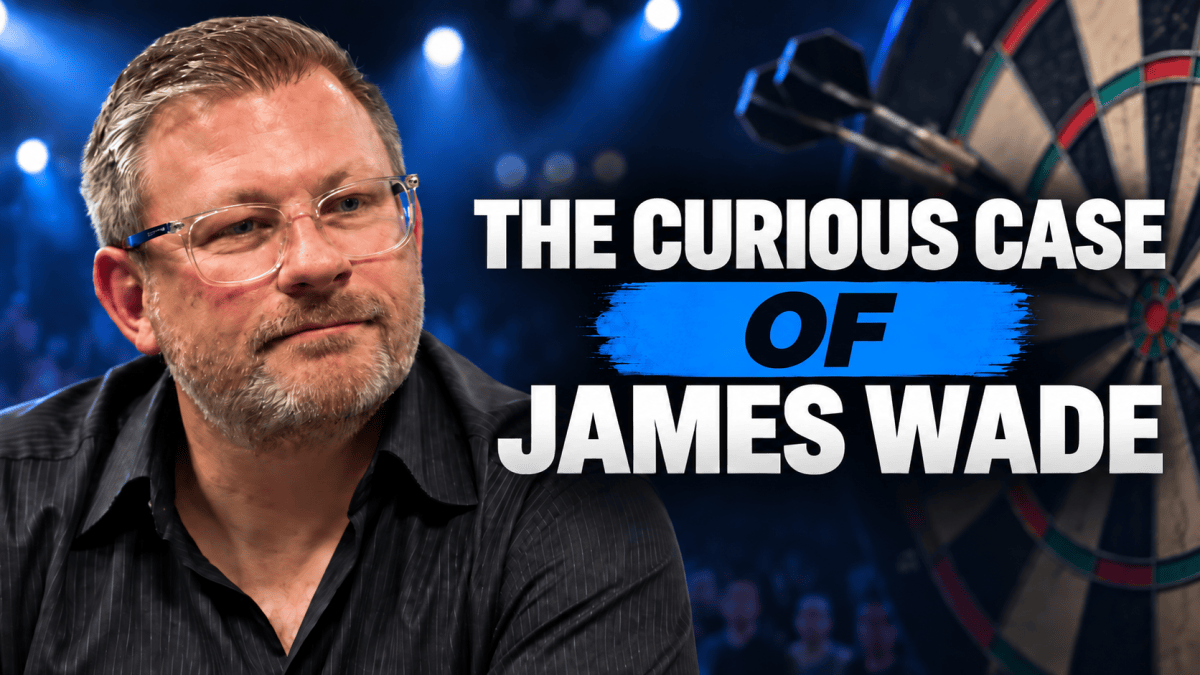

Ask darts fans to name the greatest players of all time and the same names quickly crop up: Phil Taylor, Michael van Gerwen and, increasingly, Luke Littler. But after James Wade’s recent Euro Tour win in Antwerp, another familiar debate has resurfaced: where does Wade belong among the game’s all-time greats, and how much should his lack of a World Championship count against him?
Wade is unquestionably one of the outstanding players of his generation. He has won 42 PDC titles, including 11 majors, putting him behind only Taylor, van Gerwen and Littler for PDC major titles. He has been at the top of the game for more than 20 years, reaching major finals in all but four of them and ending 16 years inside the world’s top 10, including six consecutive years inside the top three.
Surely that résumé puts him securely in the top 10 of all time? Perhaps not.
Wade’s lack of a world title inevitably complicates the argument. Gary Anderson, Adrian Lewis and Peter Wright are all two-time PDC world champions, Raymond van Barneveld won five world titles and John Part three. Earlier generations produced multiple champions such as Eric Bristow, John Lowe and Jocky Wilson, while more recent winners including Luke Humphries, Gerwyn Price, Rob Cross and Michael Smith all have the biggest title in darts on their CV.
The question is how much weight one tournament — even the biggest tournament in the sport — should carry when judging an entire career.
Many would argue that the importance of world titles is overstated. With its £1 million top prize, the World Championship has a huge impact on the rankings for the following two years, and perhaps it has a similarly outsized influence on all-time discussions. Can Lewis, a back-to-back world champion in 2011 and 2012, really be considered to have had a better career than Wade? Outside those titles, he won only two other majors, neither generally regarded as being among the PDC’s very biggest events.
Wilson presents a similar question. Two world titles give him an obvious claim, but his wider CV does not contain the same depth of major success as Wade’s.
If we simply look at titles won, Wade has a strong case for the top 10. Dig a little deeper, though, and another issue appears.
His list of opponents in major finals has not always represented a who’s who of elite darts. Terry Jenkins twice, Gary Mawson and Mervyn King were his first four victims, none of whom won a PDC major. His next two titles came against Lewis, before his breakthrough in 2011, and Taylor in a best-of-11-leg final.
Later victories came against Wes Newton, King again, Simon Whitlock and Smith during a period when he had become known for finishing runner-up. Wade’s most recent major triumph came against Humphries, but overall it is fair to ask whether the quality of opposition he defeated in those finals slightly flatters the raw total.
Of course, ultimately you can only beat the player in front of you. Winning is what matters. But when judging where someone belongs among the all-time greats, every angle is worth considering.
The simplest way for Wade to end the debate would be to win a World Championship. If he were to lift the Sid Waddell Trophy at Alexandra Palace this year, he would immediately strengthen his case against the one-time world champions and make comparisons with Lewis, Wilson and Part far more difficult. It would push him much closer to the top five conversation alongside names such as van Barneveld, Bristow and Anderson.

The problem is that Wade’s record at the World Championship remains the weakest part of his résumé.
He has never reached the final. There have been four semi-final defeats and five quarter-final exits, while his last four appearances have all ended in the second round. The most painful surely came in 2012, when he led Lewis 5-1 in the semi-final before losing 6-5.
Wade has spoken about wanting to be with his family over the Christmas period, which may help explain why the tournament has not always brought out his best. His relentless style also appears better suited to matchplay than set play, where it can be harder to grind opponents down over time.
It may feel as though his chance to become world champion has passed, but not everyone agrees. Respected darts analyst Matt Edgar has argued that Wade is currently playing some of the best darts of his career, despite the FDI rankings placing him as low as 12th.
With Wade currently due to be seeded sixth, he should have a favourable route on paper until the quarter-finals. His recent record at Alexandra Palace means a deep run can hardly be taken for granted, but it is not beyond the realms of possibility.
And that is what makes his legacy so interesting.
I’m still not convinced Wade has a convincing case for the top five, and even his place in the top 10 becomes less clear when you look beyond the raw number of titles. But one World Championship would change the discussion completely.
Not that Wade himself would care one iota about any of this. Listening to other people’s opinions has never exactly been his style.
Leave a Reply